
The Alcohol Policy Alliance – Ghana (GhanAPA) Launches its Civil Society Shadow Report On Ghana’s Implementation of the Framework for Implementing the Global Alcohol Action Plan 2022-2030 in the WHO African Region.
On 29 January 2026, the Alcohol Policy Alliance Ghana launched the Civil Society Shadow Report on Ghana’s Implementation of the African Region Framework on the Global Alcohol Action Plan 2022 to 2030 at the CSIR STEPRI Dr. Frempong Hall in Accra.
The launch aimed to draw government attention to the urgent need for the passage of the Draft National Alcohol Control Regulations. The Shadow Report highlights Ghana’s progress, challenges, and gaps in implementing the African Regional Framework on the Global Alcohol Action Plan 2022 to 2030.
The event brought together representatives from the Ministry of Health, Food and Drugs Authority, Mental Health Authority, Ghana Health Service, National Road Safety Authority, civil society organizations, and members of the media.
The Chairman for the event, Yussif Issaka Jajah, emphasized the urgent need for government action to address alcohol related harm in Ghana.
He called for the Passage of the Alcohol Control Legislative Instrument, regulation of aggressive alcohol marketing especially towards young people, enforcement of mandatory health warnings on alcohol products.
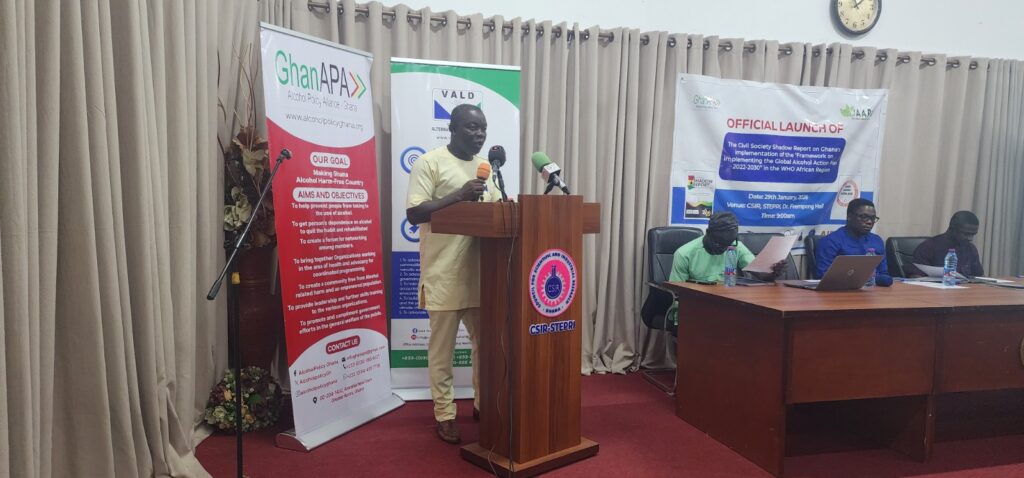
He stressed that harmful alcohol use continues to contribute to non-communicable diseases, road traffic crashes, violence, and reduced productivity, creating a growing burden on families, communities, and national institutions.
Professor Nuworza Kugbey from the University of Environment and Sustainable Development highlighted the growing rate of alcohol consumption among Ghanaian youth.
He noted that about 13 percent of Ghanaian youth consume alcohol excessively, alcohol use among adolescents is linked to poor academic performance, violence, injuries, and mental health challenges, multi sectoral action and evidence based school interventions are urgently needed
Luqman Usman, the consultant who developed the Shadow Report, noted that although Ghana adopted a National Alcohol Policy in 2016, implementation remains weak.
Key concerns raised included:
Absence of a National Alcohol Commission
Weak coordination among implementing agencies
Limited funding and resources for enforcement
Gaps in monitoring and accountability systems
He emphasized the need for stronger collaboration among institutions including the Ministry of Health, Food and Drugs Authority, and Mental Health Authority.
Mr Issah Ali, Head of Secretariat of the West African Alcohol Policy Alliance, stated that civil society organizations would continue to monitor implementation efforts and hold duty bearers accountable.
He described the Shadow Report as:
“A tool for action not just to expose gaps but to provide evidence for government, civil society, and development partners to drive meaningful policy and legislative implementation.”
He further urged the Ministry of Health to use the report to advance stronger alcohol control measures in Ghana.
Ministry of Health Reaffirms Commitment
Representing the Ministry of Health, Mark Atuahene acknowledged that the alcohol control policy process has faced several challenges but assured stakeholders that work is ongoing to develop a comprehensive Legislative Instrument.
He called for:
Stronger enforcement of age restrictions for alcohol sales
Greater involvement of local government authorities
Increased public education by the media on alcohol related harms
A coordinated multi sectoral approach to alcohol control
Other stakeholders including the Mental Health Authority, National Road Safety Authority, and Ghana Health Service also reiterated the urgent need for the passage and enforcement of the National Alcohol Control Regulations.
Some key recommendations adopted during the launch included:
- Parliament, Ministry of Health, and Food and Drugs Authority should prioritize passage of the Draft Alcohol Control Regulations.
- Government should ensure sustained funding for multi sectoral alcohol policy coordination while protecting policymaking from alcohol industry influence.
- Ghana should adopt comprehensive restrictions on alcohol advertising, promotion, and sponsorship especially those targeting young people.
The launch reinforced the growing call from civil society, health institutions and policymakers for urgent action to strengthen alcohol control measures and protect public health in Ghana.